
How to Build a Security Hiring Call List From Job Applicants
Posted 20 Oct 2026 by OfficerListA security job posting gets applications. Filling the position takes a clear next step.
When you need people for a new contract, recurring shifts, or an upcoming assignment, reviewing resumes is only part of the work. You also need to know who fits the role, who is available, and who should receive the first call.
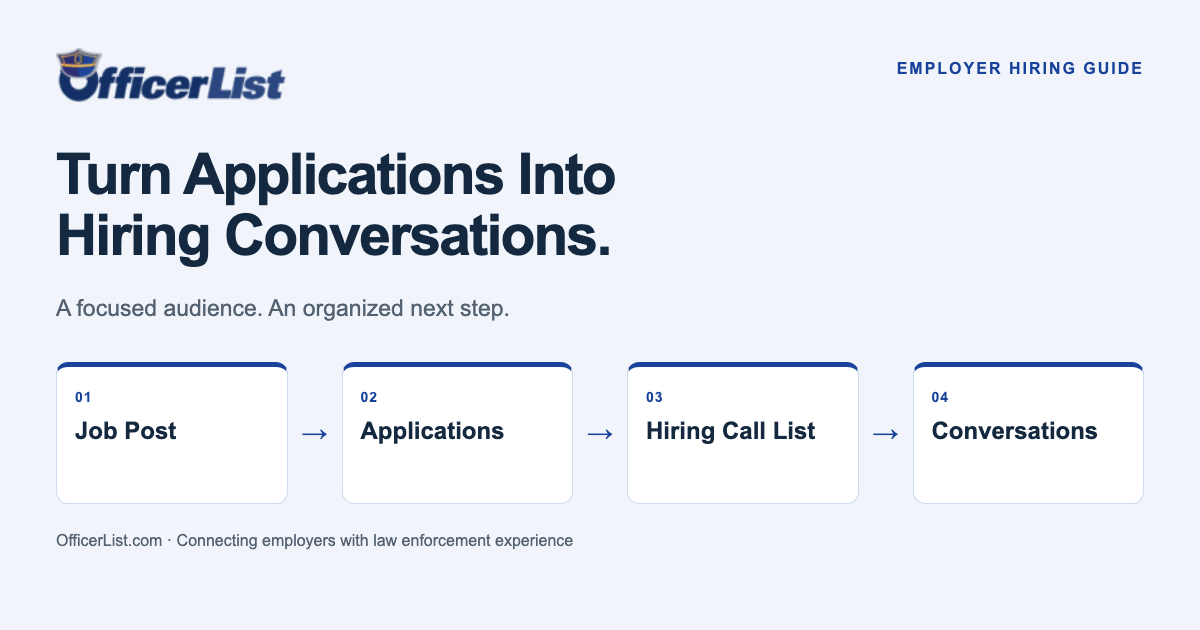
A security hiring call list turns applications into an organized follow-up process. For employers recruiting candidates with law enforcement backgrounds, it helps connect the experience on a resume with the practical requirements of the assignment.
What is a security hiring call list?
A security hiring call list is a working shortlist of applicants to contact about a specific opening.
It is not a purchased contact database or permission to contact every person in a professional network. It starts with people who applied for your opportunity and organizes the information needed to move those applications forward.
A useful list answers five questions:
- Who is the applicant?
- How can your hiring team reach them?
- What relevant experience have they provided?
- Which requirements still need confirmation?
- What is the next action?
The goal is simple: spend less time sorting applications and more time having productive hiring conversations.
Start with the assignment, not the resume
Before deciding whom to call, define what the job actually requires.
A corporate lobby assignment may emphasize visitor management and professional communication. Event security may require coordination with venue staff and comfort working around crowds. A mobile assignment may involve travel between locations.
Write down the essentials:
- Work location and expected travel.
- Dates, shifts, and assignment duration.
- Pay range and employment arrangement.
- Core responsibilities.
- Required qualifications.
- Relevant experience that is preferred, rather than essential.
Use those requirements consistently when reviewing applicants. A law enforcement background can be relevant, but it does not establish availability or suitability for every private-sector role.
Build a list your team can act on
Keep the call list practical. A complicated spreadsheet that nobody updates creates another administrative task.
Start with these fields:
- Applicant name and preferred contact method.
- Position applied for.
- Relevant experience.
- Availability, marked “unconfirmed” until discussed.
- Resume link or reference.
- Questions for the initial call.
- Contact status and next follow-up date.
Distinguish what the applicant reported from what your team has confirmed. If someone lists a qualification on a resume, do not treat it as verified simply because it appears in your spreadsheet.
Limit access to staff involved in hiring, and avoid adding sensitive personal details that do not belong in a recruiting worksheet.
Prioritize job fit and availability
The strongest first calls are not necessarily the applicants with the longest resumes.
Start with candidates whose stated experience aligns with the assignment and whose location and reported availability appear workable. Use the same job-related criteria for everyone.
An experienced candidate who cannot work your required schedule is not an immediate match. Another applicant with directly relevant experience and compatible availability may warrant an earlier conversation.
Keep a separate status for promising applicants who are unavailable for this opening. Ask whether they would like to hear about future suitable opportunities rather than assuming ongoing interest.
Make the first call specific
An initial hiring call should confirm the basics before either side invests time in a longer interview.
A straightforward opening might be:
“You applied for our security position in [location]. The assignment is [schedule], with a pay range of [range]. Are you still interested and available to discuss it?”
Then cover:
- Whether the applicant understands the duties.
- Availability for the full assignment.
- Relevant experience with similar work.
- Qualifications that require further review.
- The next step and expected timeline.
Record the outcome immediately. “Call back Thursday afternoon” is more useful than “good candidate.”
Where OfficerList fits
OfficerList gives employers a focused place to reach a law-enforcement audience. Its call-list and applicant contact/resume tools support the work that comes after posting: reviewing applicants and organizing outreach.
Employers can request a call list with their applicants’ contact information, along with a PDF containing all applicant resumes, from the OfficerList team.
The value is not simply another place to display a vacancy. It is connecting a relevant audience with a practical employer follow-up process.
Employers still make their own hiring decisions and confirm each candidate’s qualifications, suitability, and availability.
If your need is a business service rather than an employee, the OfficerList Directory offers a separate discovery path. Keep that distinction clear: recruiting an applicant and evaluating a service provider are different processes.
Measure conversations, not just applications
Application volume alone does not tell you whether recruiting is working.
Track how many applicants meet your stated requirements, how many you reach, how many are available, and how many move to the next stage.
If applicants repeatedly decline because of the schedule or pay, revisit the posting. If suitable applicants are waiting days for a response, improve follow-up.
A focused audience gets your opportunity in front of relevant people. An organized call list helps your team take the next step.
Ready to reach candidates with law enforcement experience? Explore OfficerList’s employer posting options and put a clear follow-up process behind your next opening.
Need to hire off-duty or retired officers?
OfficerList helps employers post security work and reach active or retired law enforcement professionals for private security, event security, school security, traffic control, and related assignments.
Learn how to hire officers through OfficerListRecent Posts
- How to Build a Security Hiring Call List From Job Applicants
- How to Write an Off-Duty Security Job Posting That Attracts Qualified Applicants
- How Security Companies Can Recruit Retired Police Officers Nationwide
- BODYGUARDS (They’re Not Just for the Rich Anymore)
- How Much Does It Cost To Hire A Bodyguard?