
Jobs for Retired Police Officers: Your Next Career
Posted 07 Jul 2017 by OfficerListUpdated October 19, 2026
Retirement from law enforcement does not have to mean leaving your experience behind. Jobs for retired police officers can include corporate security, investigations, executive protection, training, and security consulting. The best fit depends on how much you want to work, the responsibilities you want to keep, and the qualifications your next role requires.
You do not have to choose another security role. Your experience in supervision, documentation, problem-solving, and public communication may also transfer to operations, compliance, customer-facing work, or a new profession. Start with the life you want after retirement, then compare the work that supports it.
Compare career options after police retirement
These are paths to explore, not guarantees of eligibility, pay, or openings. A job title alone does not tell you whether a position is armed, licensed, physically demanding, or compatible with your pension rules.
If consulting interests you, explore security consulting after policing before deciding whether to join a firm or build an independent practice.
Decide between part-time and full-time work
Neither option is automatically better for a retired officer. A predictable part-time schedule may suit one person; benefits, a team environment, or a new long-term career may matter more to another.
- Hours: How many days or hours do you want to work? Are nights, holidays, or last-minute shifts acceptable?
- Travel: Set a realistic commute and decide whether overnight travel fits your plans.
- Physical demands: Ask about standing, driving, lifting, equipment, and emergency-response expectations.
- Income and benefits: Compare expected hours, compensation, benefits, and work-related expenses—not just an advertised hourly rate.
- Responsibilities: Decide whether you want direct public contact, supervision, teaching, administrative work, or a different field entirely.
Check licensing before accepting work
Requirements depend on the jurisdiction, duties, and whether you work for an employer or operate your own business. Prior police service does not automatically authorize every kind of security, investigative, training, or consulting work. Ask the relevant licensing authority which registration, training, permits, and exemptions apply to your circumstances.
For officers considering security work in New York
Start with the New York Department of State's security guard FAQs and training requirements. Registration and training exemptions are separate questions. Do not assume retirement eliminates registration requirements, that every retired officer qualifies for the same training exemption, or that every security position requires armed status. Confirm the current requirements for your background and intended role before paying for a course or accepting an assignment.
This guide does not promise an application-processing timeline. Check current instructions, required documents, and your eligibility with the responsible agency.
LEOSA is not a substitute for employment requirements
18 U.S.C. § 926C, part of the Law Enforcement Officers Safety Act often called LEOSA or HR218, addresses concealed carry by qualified retired law enforcement officers who meet its conditions. Do not treat it as a security-guard license, permission to perform paid armed work, or a grant of police authority. Confirm occupational requirements and applicable restrictions separately, including when an assignment involves travel.
Translate police experience into civilian skills
Help an employer understand what you can do for their organization. Use accurate examples and explain specialized terms rather than relying on rank, unit names, or agency acronyms.
- Investigations: Describe interviewing, evidence review, research, and clear findings.
- Incident reporting: Explain how you document events accurately and communicate information to decision-makers.
- Supervision: Describe team size, scheduling, coaching, and coordination where those facts apply.
- De-escalation: Explain your experience communicating under pressure and resolving conflict.
Use results you can substantiate, and protect confidential information. For more detail, learn how to format your law-enforcement experience for security employers.
Evaluate the offer, not just the job title
Before agreeing to work, research prospective employers and get the key terms in writing.
- What are the actual duties, location, schedule, and reporting relationships?
- What compensation is offered, which hours are paid, and who covers travel, equipment, and training expenses?
- Is the role employee or contractor work, and what does that mean for taxes, benefits, and insurance?
- Which licenses and qualifications must you maintain, and who verifies them?
- What liability coverage applies to you and to the assignment?
- Could the work affect pension payments or other benefits? Ask your pension administrator about your specific plan, employer, and circumstances before starting.
Your first 30 days: a practical checklist
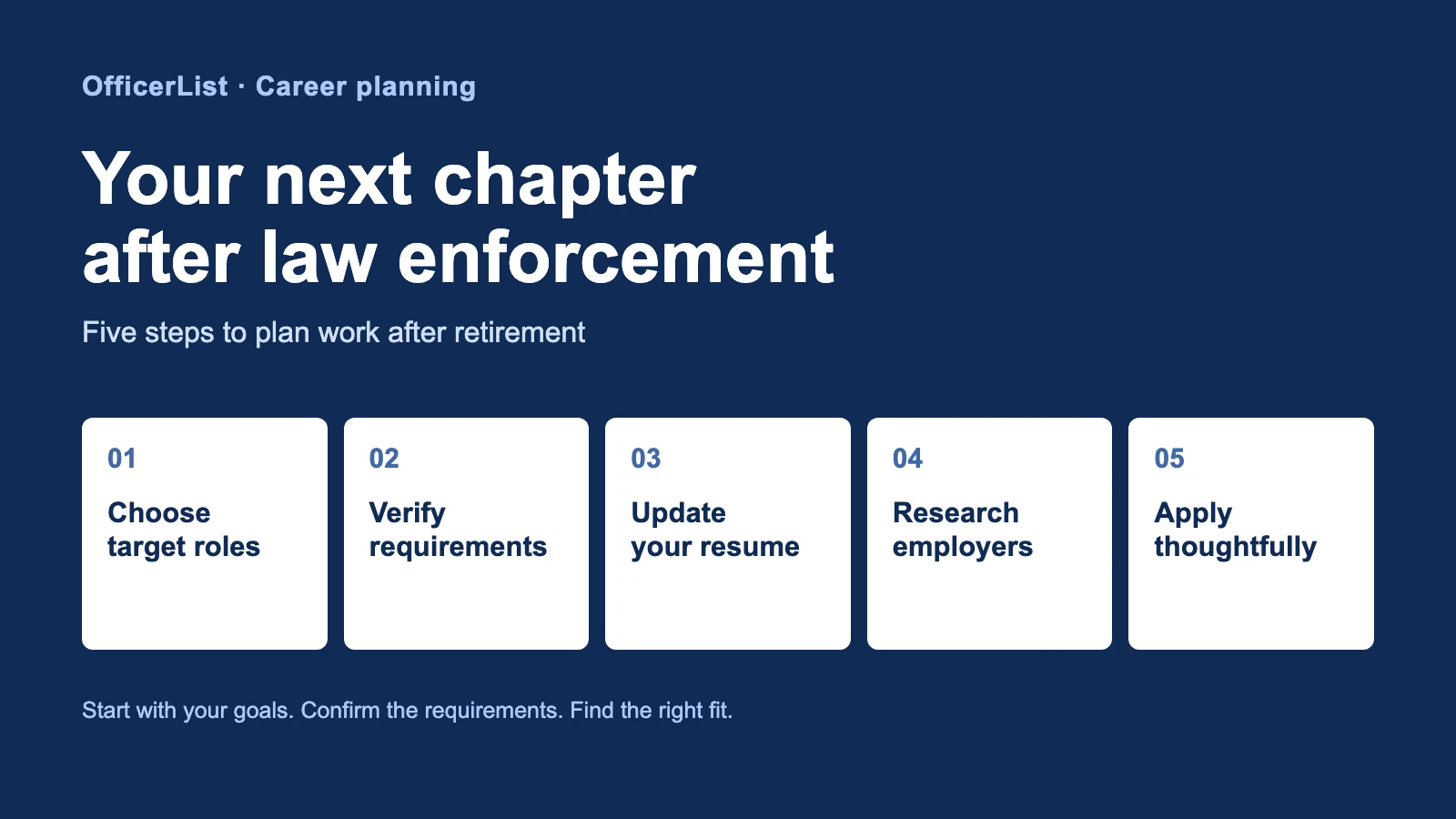
- Choose target roles. Pick two or three options and write down your hours, travel limits, and income goals.
- Verify requirements. Check licensing, training, insurance, and pension considerations before committing to a role.
- Update your resume. Translate relevant experience into clear skills and examples.
- Research employers. Compare duties, schedules, reputation, and written terms.
- Apply thoughtfully. Tailor each application, track responses, and use interviews to confirm fit.
You can spread these steps over your first month; credentialing or a career change may take longer. Focus on informed choices rather than rushing into the first available assignment.
Frequently asked questions
What part-time jobs can retired officers pursue?
Options may include site or event security, investigations support, training, protective work, and consulting. Availability and eligibility depend on your qualifications, local requirements, and the employer. Compare the actual schedule and duties before applying.
Do retired police officers need a security license?
It depends on the jurisdiction and the work. Registration, training exemptions, firearms permissions, and business licensing can have different rules. Check with the relevant authority rather than assuming prior service or LEOSA eligibility covers every requirement.
Can working after retirement affect my pension?
It can, depending on your pension plan, age, employer, earnings, and applicable rules. Ask your pension administrator how the proposed job would be treated and whether reporting or approval is required. Do not assume another retiree's situation matches yours.
Ready to explore opportunities? Browse OfficerList jobs and compare current listings with your preferred schedule, experience, and verified qualifications.
Licensing and benefit rules can change. Use the linked government guidance and your pension administrator to confirm the requirements that apply to you.
Recent Posts
- Hiring Security for Multiple Locations: A Buyer’s Checklist
- Best Job Boards for Hiring Retired Police Officers: An Employer’s Guide
- How to Build a Security Hiring Call List From Job Applicants
- How to Write an Off-Duty Security Job Posting That Attracts Qualified Applicants
- How Security Companies Can Recruit Retired Police Officers Nationwide