
Transitioning from law enforcement to civilian jobs can be tough, especially with career gaps. Employers often view these gaps skeptically, questioning reliability, motivation, and skills. But with the right approach, you can turn these gaps into strengths. Start by choosing a resume format that shifts focus from dates to skills. Highlight transferable abilities like leadership, crisis management, and communication. Use measurable achievements to show impact and address gaps briefly but confidently. Platforms like OfficerList can connect you with job opportunities tailored to your expertise. Here’s how to make your resume work for you.
Chronological resumes can make employment gaps painfully obvious by focusing on dates, which often draws attention away from your qualifications. For retired officers with gaps in their work history, this format may create a negative impression before a hiring manager even gets to your skills and achievements.
Instead, choose a format that highlights what you bring to the table – your skills and accomplishments. A 2024 survey by ResumeBuilder found that over 60% of hiring managers prefer resumes that emphasize measurable achievements and clearly defined skills, especially for candidates with career gaps or non-linear job histories. Even better, resumes using a combination format are 24% more likely to pass initial ATS (Applicant Tracking System) screening compared to strictly chronological ones for candidates with employment gaps.
The functional resume format is structured around your skills and achievements rather than a timeline. For example, instead of listing "Police Officer, 2015-2020" followed by job duties, you might create sections like "Leadership", "Crisis Management", and "Community Relations." Under each section, you include specific accomplishments that showcase your expertise.
Here’s an example of what this could look like under a "Leadership" section:
"Led a team of 12 officers in high-pressure situations, achieving a 20% reduction in response times."
This approach focuses on your capabilities while sidestepping the issue of dates.
The combination (or hybrid) format blends elements of both functional and chronological resumes. It starts with a professional summary and a skills section, followed by a condensed work history. This format allows you to lead with your strongest skills while still including a brief timeline for employers who expect one. It’s a great way to make a strong first impression while addressing gaps in a subtle way.
| Format Type | Focus Area | Best For | Key Advantage |
|---|---|---|---|
| Functional | Skills & achievements | Career changers, big gaps | Minimizes focus on dates |
| Combination | Skills + brief history | Diverse experience, some gaps | Balances showcasing skills with work history |
| Chronological | Work history timeline | Continuous careers | Highlights clear progression (not ideal for gaps) |
These formats allow you to present your background in a way that emphasizes your strengths rather than drawing attention to gaps.
How you organize your resume can significantly influence how hiring managers perceive your qualifications. Start with a professional summary that ties your law enforcement experience to the requirements of civilian roles. This opening section helps employers immediately see the value you bring, even before they notice any gaps.
Use bold headers and bullet points to make your resume easy to read and ATS-friendly. Keep the layout clean and scannable, with plenty of white space. Stick to one page and focus on the last 10 years of relevant experience. This forces you to zero in on your most impressive and applicable achievements.
Whenever possible, quantify your accomplishments. For instance, instead of saying, "Managed community outreach programs", you could write:
"Coordinated community outreach initiatives that improved public safety awareness by 35% across three neighborhoods."
Numbers make your achievements more tangible and easier for employers to appreciate.
The shift toward skills-based hiring in the U.S. works to your advantage as a retired officer. Employers are increasingly prioritizing demonstrated competencies over continuous employment history, making functional and combination formats particularly effective. Your law enforcement background offers transferable skills like conflict resolution, leadership, and emergency management – qualities that align well with many civilian roles.
Consider using platforms like OfficerList, which provide resume tools and templates specifically designed for law enforcement professionals transitioning to civilian careers. These resources can help you craft a functional or combination resume that highlights the skills and experiences civilian employers value most in retired officers.
Enhance your well-crafted resume by showcasing the valuable skills you gained during your law enforcement career. These abilities form a toolkit that civilian employers actively look for, but it’s essential to translate them into terms that align with civilian job expectations. This reframing helps bridge the gap between your experience and the needs of the roles you’re targeting.
Many retired officers undervalue themselves, thinking, "I’m just a cop." But your background likely includes expertise in crisis management, team leadership, conflict resolution, and regulatory compliance – skills that are highly sought after in corporate and other civilian environments. The key to landing interviews lies in how effectively you present these strengths.
Once you’ve chosen the right resume format, the next step is to clearly highlight your transferable skills.
Adding a dedicated skills section to your resume is a great way to translate your law enforcement experience into terms that resonate with civilian employers. Place this section prominently, ideally right after your professional summary, to immediately draw a hiring manager’s attention.
Use bullet points to structure your skills section, aligning your abilities with the specific requirements of the job you’re applying for. Avoid using police-specific jargon. Instead, focus on describing the outcomes and value of your actions. For instance, instead of saying you "conducted investigations", you could write, "Managed complex investigative projects requiring strong analytical skills, attention to detail, and collaboration across departments."
Include a mix of hard and soft skills. Hard skills might include areas like compliance management, data analysis, or technical report writing. Soft skills could highlight leadership, communication, problem-solving, and decision-making under pressure. By balancing both, you’ll demonstrate your technical expertise and interpersonal strengths.
Here’s how specific law enforcement skills can translate into civilian job benefits:
Leadership and Team Management
Your experience leading patrol units, training officers, or coordinating multi-agency operations shows you can guide teams toward shared objectives. For example:
"Led diverse teams in high-pressure environments, ensuring clear communication, accountability, and successful outcomes."
Crisis Management and Problem-Solving
Handling emergencies and de-escalating conflicts demonstrates your ability to assess situations quickly and implement effective solutions. Consider phrasing it as:
"Proven ability to evaluate complex scenarios, devise actionable strategies, and execute decisive plans under time constraints."
Communication and Interpersonal Skills
Skills developed through community policing, witness interviews, and court testimony enable you to communicate effectively with diverse audiences. You could frame this as:
"Skilled in building relationships with stakeholders, presenting complex information clearly, and facilitating productive dialogue."
| Police Jargon | Civilian-Friendly Translation |
|---|---|
| "Supervised patrol operations and coordinated tactical responses" | "Directed operational teams and strategic initiatives, ensuring efficient resource use and goal achievement" |
| "Processed evidence and maintained chain of custody protocols" | "Managed sensitive documentation with strict adherence to compliance and quality standards" |
Attention to Detail and Compliance
Your experience with evidence handling, report writing, and strict adherence to protocols highlights your precision and regulatory expertise. Reframe it as:
"Extensive experience ensuring accuracy and compliance with regulatory and documentation standards."
Conflict Resolution and Negotiation
Your ability to handle disputes and mediate tense situations is invaluable in any workplace. You might describe it as:
"Experienced in resolving conflicts, negotiating solutions, and maintaining professional relationships in challenging conditions."
When adapting these skills, focus on the value you brought to your organization or community. Instead of simply listing responsibilities, explain the impact of your actions. This approach helps hiring managers see the tangible benefits you can bring to their team.
For additional support, consider platforms like OfficerList, which connect law enforcement professionals with employers who value their unique experience. These platforms can help streamline your job search and increase your chances of landing interviews for roles that align with your skills.
When you quantify your achievements, you turn vague claims into concrete evidence. This approach grabs hiring managers’ attention and shows your ability to deliver measurable results. For retired officers, this is especially important – it helps civilian employers understand the real-world impact of your law enforcement career.
The key difference between a weak resume and a strong one often lies in specificity. Broad, generic statements can leave hiring managers guessing about your contributions. But when you include measurable outcomes, you offer undeniable proof of your capabilities.
For instance, instead of saying, "Improved department efficiency", explain how you streamlined operations, reduced response times, or increased case closure rates. Numbers and specifics make all the difference.
Here are a few examples that show how to turn general claims into impactful, results-driven statements:
| Weak Statement | Strong, Quantified Statement |
|---|---|
| "Managed a large team of officers" | "Supervised a patrol team across multiple shifts, maintaining 98% attendance and cutting overtime costs by 15%" |
| "Handled training responsibilities" | "Designed and led officer training programs, improving operational protocols and reducing errors by 20%" |
| "Worked on community outreach" | "Organized and executed community events, increasing citizen satisfaction ratings by 25%" |
When crafting your statements, think beyond arrest numbers or tickets issued. Highlight achievements in areas like efficiency, cost savings, improved training outcomes, or process improvements. For example, if you managed a departmental budget, mention how you optimized spending while maintaining operational readiness. Employers value fiscal responsibility as much as they value operational effectiveness.
Time-based accomplishments also stand out. Whether you shortened response times, sped up training programs, or streamlined administrative processes, these examples show your ability to enhance efficiency – qualities that resonate across industries.
Once you’ve quantified your achievements, the next step is to translate them into terms that civilian employers can easily understand.
Quantifying your achievements is only half the battle. To make them truly impactful, you need to frame them in language that appeals to civilian employers. This means focusing on universal business outcomes instead of law enforcement-specific activities.
Start by identifying achievements that showcase transferable skills like leadership, project management, process improvement, training, or relationship building. Then, present these in terms that demonstrate the value you brought to the organization.
For example:
Crisis management is another area where your skills shine. Highlight your ability to make decisions under pressure, coordinate resources, and resolve high-stakes situations. These qualities are assets in any professional environment.
Once you’ve tailored your resume to showcase your skills, the next step is tackling career gaps with poise. These gaps don’t have to hold you back. Many retired officers face them during transitions, and addressing them directly and confidently can strengthen your overall narrative to potential employers.
Timing is key when deciding whether to address gaps. If the gap is less than six months, you might not need to mention it at all – focus instead on your accomplishments and skills. For longer gaps, a brief, honest explanation works better than overcomplicating things. The goal is to reframe these periods as opportunities for growth and development.
Think of career gaps as moments that reflect your commitment to personal and professional growth. Use these periods to highlight activities that demonstrate your leadership abilities and dedication to staying sharp.
For example, professional development activities are excellent ways to fill gaps. Completing certifications, attending training sessions, or pursuing further education shows initiative and preparation for your next career step. Whether it’s technology courses, project management training, or industry-specific certifications, these efforts add value to your resume.
If your gap involved family responsibilities, that’s okay too. Acknowledge this time briefly and emphasize your readiness to return to work. Employers appreciate honesty and value candidates who can balance priorities.
The key is tying these activities to the skills that hiring managers are looking for. Did you organize community events? Highlight your project management and coordination skills. Did you provide informal consulting? Showcase your expertise and ability to build strong client relationships.
When addressing gaps, keep it short and forward-looking. Use employment dates by year and include a simple note like "Career Transition Period" to minimize attention on the gap. In cover letters, one or two sentences are enough – focus on what you achieved during the gap and how it prepared you for the role you’re pursuing.
Avoid over-explaining or sounding defensive. There’s no need to apologize or share unnecessary personal details. Stay positive. For instance, instead of saying, "I couldn’t find work", try, "I took time to find the right opportunity."
End on a high note. After addressing the gap, shift the focus to your excitement for the role and how your experience makes you a strong fit. This moves the conversation from your past to your potential contributions.
Employers understand that career gaps happen. Many have experienced them too. What truly matters is how confidently you present your story and how you use those periods to showcase your readiness for the next step.
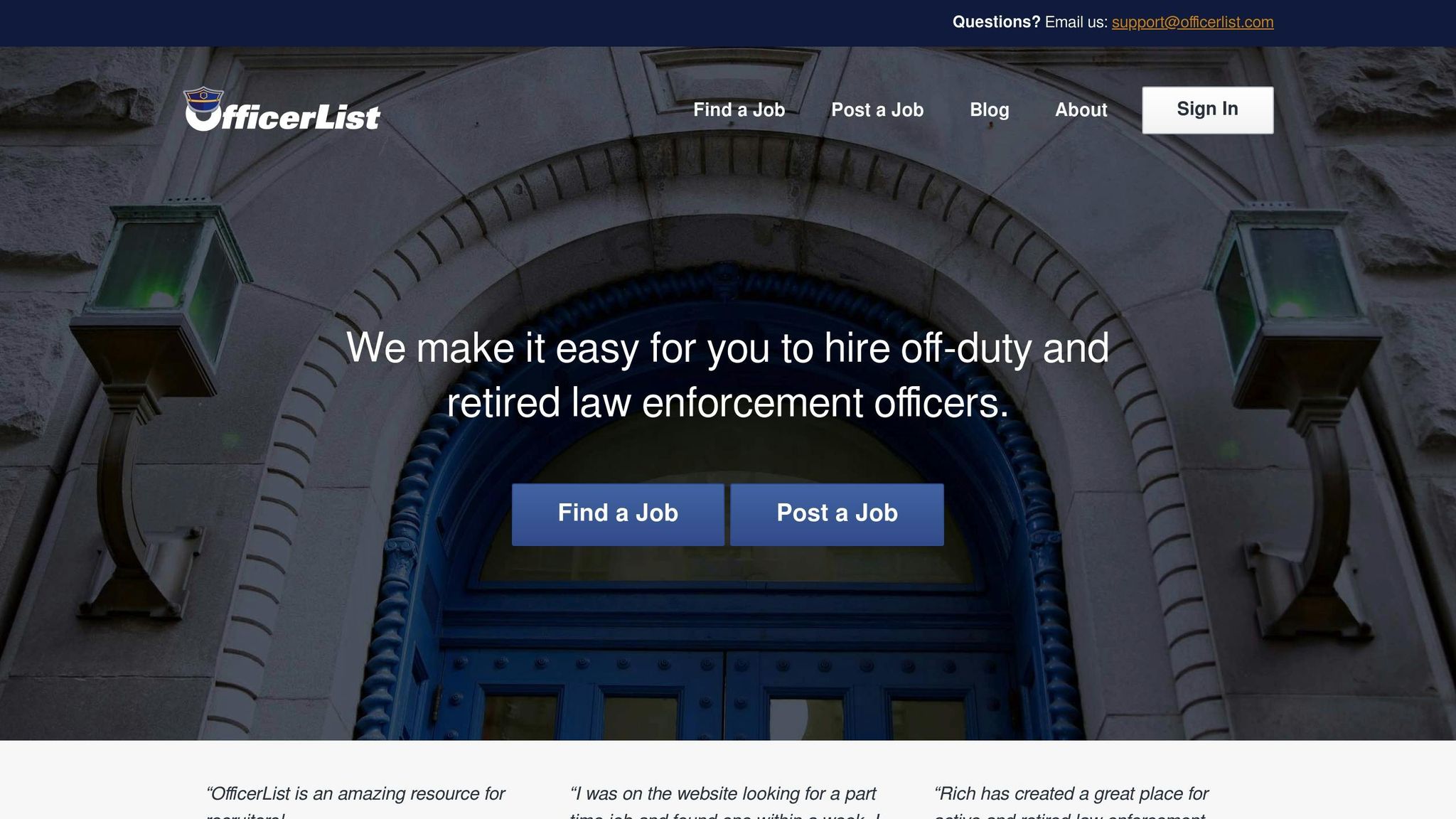
Once your polished resume is ready, it’s time to focus on opportunities that truly value your law enforcement background. Traditional job boards often fail to highlight the unique skills that retired officers bring to the table. That’s where specialized platforms like OfficerList come in, connecting you with employers who appreciate and seek out your expertise.
OfficerList is a dedicated job site designed specifically for active and retired law enforcement officers. Unlike general job boards, this platform ensures your experience stands out, linking you directly to employers who recognize the value of your training and service.
OfficerList offers a range of tools tailored to help officers transition into civilian roles. One standout feature is LiveResume, which enables you to create an industry-specific resume that emphasizes your law enforcement experience. This feature simplifies the application process, often allowing you to apply with just one click using a format that resonates with civilian employers.
What makes OfficerList even more effective is its selection of exclusive job postings. The platform hosts a variety of listings, from security companies to private employers, offering opportunities that align with your skills and experience.
"With OfficerList, I receive emails as soon as jobs are posted & for jobs that are specifically related to my field of interest."
– Nick, Officer
In addition to job listings, OfficerList provides a secure online community, marketplace, and forum for verified law enforcement officers. This private network allows you to connect with other officers discreetly, ensuring privacy and anonymity. It’s particularly helpful if you’re still employed or in the midst of transitioning, as you can explore opportunities without drawing attention.
Perhaps one of the best perks is that OfficerList is completely free for law enforcement officers. There are no hidden fees or subscriptions – just straightforward access to jobs that match your expertise and career goals.
OfficerList takes a targeted approach to job searching, connecting you with employers who value your unique skill set. This focus increases your chances of finding roles that align with your background and aspirations.
"I was on the website looking for a part-time job and found one within a week. I will highly recommend this website to all LEO’s."
– Sergeant Jeffrey, Retired NYPD
As a verified member, you can view and respond to all job listings while setting terms that suit your needs. Whether you’re looking for flexible hours, specific salary requirements, or long-term career opportunities, the platform gives you full control over your transition.
The site is especially helpful for finding jobs tailored to your training, whether it’s full-time security work, part-time consulting, or something entirely different. Its emphasis on discretion ensures that your search remains private – your profile isn’t searchable, and no sensitive information is required. This level of privacy is crucial for retired officers who want to explore their options without jeopardizing their reputation or current employment.
"Rich has created a great place for active and retired law enforcement officer’s to be able to find side jobs to supplement their incomes…"
– Henry, Mount Vernon Police Department
Making the shift from law enforcement to civilian careers can feel daunting, but a well-crafted resume can make all the difference. With the right strategy, you can effectively showcase your value to potential employers.
Start with a functional or combination resume format that emphasizes your skills rather than focusing solely on dates. A dedicated skills section paired with measurable accomplishments will help your resume stand out. This approach ensures every part of your resume demonstrates your readiness for civilian roles.
When listing your achievements, go beyond simply outlining duties. Use numbers and specific examples to show the impact you’ve made. For instance, instead of saying you "led a team", highlight how your leadership improved efficiency or community engagement.
If you have employment gaps, don’t shy away from addressing them. Rather than seeing these gaps as drawbacks, frame them as opportunities for personal growth, learning, or skill-building. A clear, concise explanation shows employers that you’ve used this time wisely and are prepared for new challenges.
Finally, take advantage of specialized platforms like OfficerList. These tools are designed to bridge the gap between law enforcement experience and civilian job opportunities, offering tailored resume assistance and exclusive job postings. They can simplify the process of translating your background into a language that resonates with civilian employers.
Retired officers can effectively present their backgrounds by emphasizing skills that cross over into civilian roles, such as leadership, communication, and problem-solving. Avoid using law enforcement-specific terminology; instead, describe your experience in ways that resonate with non-law enforcement employers. For instance, talk about managing teams, resolving conflicts, or performing under pressure.
Make sure to highlight achievements that illustrate your contributions, like streamlining processes or delivering measurable outcomes. Customize your resume for each job by matching your training and experience to the specific role’s needs. Framing your skills in relatable terms helps potential employers clearly understand how your expertise aligns with their expectations.
Addressing career gaps on your resume doesn’t have to be complicated if you approach it thoughtfully. One effective strategy is to include a ‘Career Break’ section where you briefly explain how you used that time. Whether it involved volunteering, taking professional courses, or pursuing further education, this shows that the time away was productive.
Another key step is to emphasize transferable skills you’ve honed during your law enforcement career, such as leadership, problem-solving, and communication. These skills can demonstrate your value to employers, even if your work history has breaks.
To downplay gaps further, consider using a functional or hybrid resume format. These formats focus on your skills and accomplishments rather than presenting your work history in strict chronological order. This way, you can highlight your strengths and relevant experience without drawing too much attention to periods of unemployment.
OfficerList offers a platform tailored for retired law enforcement officers, making the shift to civilian careers smoother. It allows officers to build resumes suited to specific industries, apply for jobs that match their skills, and get email notifications about positions that fit their expertise.
The platform bridges the gap between officers and employers looking for skilled professionals in areas like security and other specialized roles. By streamlining the job search, OfficerList ensures officers can easily find opportunities that appreciate their unique experience.