
Starting a mentorship program in law enforcement can help agencies support new recruits, improve retention, and develop future leaders. Unlike traditional Field Training Officer (FTO) programs, mentorship focuses on long-term career growth and emotional support. Research indicates mentorship programs improve efficiency by 67%, with mentees being promoted five times more often and retention rates exceeding 69%.
To create a program, agencies should:
Programs like those in Indianapolis and Texas showcase how mentorship can address specific needs, improve officer wellness, and strengthen agency loyalty. By integrating mentorship into career development and leadership planning, agencies can create a supportive and effective workplace environment.
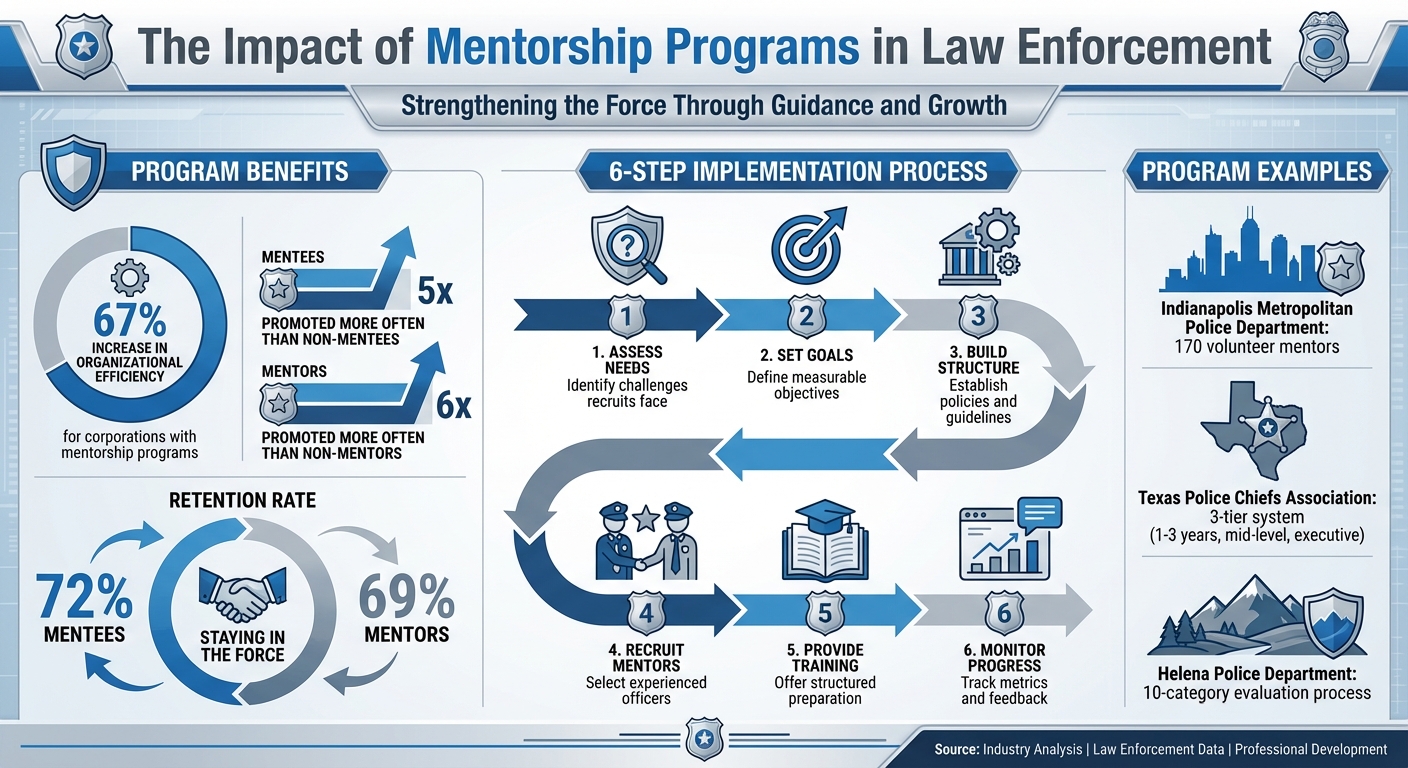
Law Enforcement Mentorship Program Benefits and Impact Statistics
Before starting a mentorship program, it’s important for agencies to take a close look at the challenges new recruits face as they transition into law enforcement. This shift from civilian life can bring immediate hurdles like irregular work hours, sleep deprivation, and family pressures. On top of that, recruits must quickly adapt to technical demands, such as learning safety protocols, mastering report writing, and handling administrative tasks. For women and minority recruits, the lack of visible role models within their agency can create additional barriers, impacting their sense of belonging and potentially affecting retention rates.
One way to pinpoint areas of improvement is by reviewing Daily Observation Reports. Look for patterns, such as recruits being marked as "Not Responding to Training", which can highlight gaps in current training efforts. Additionally, examine turnover trends across different demographics and assess whether clear pathways for career advancement exist, especially for mid-career officers. Succession planning is another critical area to review, ensuring there’s a pipeline in place for future leadership roles. These steps provide the groundwork for understanding recruits’ challenges and where support systems can make the biggest difference.
Today’s recruits, especially those from Generations Y and Z, often expect frequent feedback and a more personalized approach to support. While Field Training Officers (FTOs) focus on evaluating immediate performance during the probationary period, they usually don’t have the capacity to address long-term career concerns or provide a safe space for recruits to seek guidance without fear of formal judgment.
To fill this gap, the Indianapolis Metropolitan Police Department has introduced a mentorship program with 170 volunteer mentors. Starting from day one at the academy, recruits are matched with mentors based on shared traits like military experience, hobbies, or even a “compatibility word” (e.g., “blunt” or “funny”) to help ensure a strong personality match. This personalized approach helps recruits feel supported while navigating the challenges of their new role.
Establish clear, measurable goals that address the agency’s specific gaps. For instance, if retention is a key concern, track how retention rates for mentees compare to non-mentees over a three-year span. If increasing diversity is a priority, measure how many women or minority recruits successfully complete the academy with the help of mentorship.
The Texas Police Chiefs Association provides a strong example with its three-tiered mentorship program launched in 2019. The program includes Tier One for officers with 1–3 years of experience, Tier Two for mid-level career advancement, and Tier Three for preparing commanders for executive roles. They use ADW assessment tools to match participants based on leadership styles and require senior-level approval to demonstrate agency-wide commitment.
Agencies can also set goals for improving Field Training Officer evaluation scores, boosting leadership development rates, and reducing stress-related incidents during probation. These benchmarks provide a clear way to measure the program’s impact and refine it over time.
Once you’ve identified your agency’s needs and goals, the next step is to establish a formal framework that gives the mentorship program structure and credibility. This means appointing a program leader, setting clear guidelines, creating written agreements, and developing a structured reporting process. These elements ensure that mentor-mentee relationships remain consistent and well-organized.
It’s crucial to distinguish mentorship from Field Training Officer (FTO) responsibilities. While FTOs focus on immediate technical training, mentorship is about long-term growth and guidance. This separation allows recruits to seek advice and build connections without the fear that casual conversations will affect their formal evaluations. As Kym Craven, Executive Director of the National Association of Women Law Enforcement Executives (NAWLEE), explains:
"Formal mentoring… requires a program leader, guidelines, agreements, and a reporting process".
With the framework in place, the next steps involve creating operational policies and assigning critical roles to ensure the program runs smoothly.
Policies are the backbone of any mentorship program. They should outline how the program operates, including signed agreements, the frequency of meetings, and the program’s duration (often aligned with the probationary period). For instance, the Indianapolis Metropolitan Police Department has a policy requiring mentors to check in with their mentees weekly during Field Training. This regular interaction ensures consistency and accountability for all mentor-mentee pairs.
It’s equally important to ensure that mentoring complements, rather than overrides, official training. Officer Nicole Juday of the Indianapolis Metropolitan Police Department emphasizes:
"Mentoring never trumps training. Mentors get a recruitment guideline workbook, so they know that if the academy tells the recruit to do something, they must never disagree".
This policy safeguards the integrity of academy instruction while giving mentors the space to provide emotional support and career advice.
Additionally, the program should require senior-level approval for participants. Standardized application forms and assessment tools can help evaluate leadership styles and ensure compatibility during the mentor-mentee matching process.
After setting up these policies, the focus should shift to assembling a capable team to oversee and implement the program.
A successful mentorship program needs a dedicated team to manage its day-to-day operations. Assign a program coordinator to handle tasks like tracking participation, managing reporting, and ensuring the program stays on course. Many agencies place their mentorship programs within specialized units. For example, the Indianapolis Metropolitan Police Department operates its program through the Office of Professional Development and Wellness (OPDW), which oversees 170 volunteer mentors. Meanwhile, the Helena Police Department in Montana uses a formal selection process that involves a committee interview and a 10-category job-related evaluation – the same system they use for selecting Field Training Officers.
This structured approach ensures mentors not only have the skills required but also the dedication to help new recruits succeed. Captain Randy Ranalli of the Helena Police Department highlights the importance of mentors, stating:
"Mentors could become just as important in an agency as FTOs and first-line supervisors".
Collaboration with academy staff is also vital during the planning phase. This ensures mentors align with academy instruction, preventing confusion for recruits and creating a unified support system. Visible support from the Chief of Police can further underscore the program’s importance. The Chief can even act as a high-level mentor, particularly for succession planning. To start, consider piloting the program with a small group of trusted individuals who receive targeted training in communication and relationship-building skills.
Once your program structure is ready, the next step is finding the right mentors and matching them with mentees. This isn’t something to leave to chance – effective pairings require a thoughtful, structured approach. The aim is to build relationships grounded in compatibility, shared values, and mutual respect.
The best mentors aren’t necessarily the most senior officers. What matters most is their enthusiasm and commitment to guiding others. Captain Randy Ranalli from the Helena Police Department highlights this point: "Two important characteristics needed are enthusiasm and a genuine desire to become a mentor". Ideal mentors are experienced officers who have a solid grasp of policing fundamentals and strong interpersonal skills. They should be open to sharing their experiences, including the hurdles they’ve faced, while maintaining professionalism.
Officer Nicole Juday of the Indianapolis Metropolitan Police Department adds that mentors need a strong sense of self: "You need to have a strong sense of self to be a mentor". This self-awareness helps mentors provide guidance while keeping professional boundaries intact. It’s also essential that mentors align with academy training standards and avoid contradicting official instruction.
A formal application process ensures that qualified mentors are selected and that relevant pairing information is collected. For instance, the Indianapolis Metropolitan Police Department asks mentor applicants to submit a resume and a personal essay explaining their motivation and mentoring experience. Similarly, the Helena Police Department uses a structured evaluation system with 10 job-related categories – similar to the method for selecting Field Training Officers – to assess candidates through interviews and leadership assessments. These steps create a solid foundation for effective mentor-mentee matches.
Successful pairings require more than just aligning schedules or ranks; they depend on understanding personalities, communication styles, and career goals. At the Indianapolis Metropolitan Police Department, recruits use a "compatibility word" system to describe the type of mentor they want – choosing words like "blunt", "funny", or "supportive." On their first day at the academy, recruits also fill out match sheets with details about their military background, hobbies, and chosen compatibility word, which helps guide pairings.
Another example comes from the Texas Police Chiefs Association, which launched a statewide mentorship program in 2019. This program uses a three-tier system based on career stages: Tier One for officers with 1–3 years of experience, Tier Two for mid-level supervisors, and Tier Three for those aspiring to be chiefs. This structure ensures that mentors and mentees share similar career goals and challenges. To promote accountability, formal agreements are established, outlining how often participants should meet and what’s expected from the program. With pairings complete, the next step is preparing mentors to provide meaningful and effective support.
Choosing the right mentors is just the beginning – setting them up for success takes structured training and consistent support. Even experienced officers need guidance when stepping into a mentoring role. Proper training lays the groundwork for the ongoing support that keeps mentors effective.
A well-structured training program is essential for preparing mentors. For instance, the Indianapolis Metropolitan Police Department runs a five-day training course for its 170 volunteer mentors. The curriculum is designed to equip them with the interpersonal skills and techniques needed to guide new recruits. Here’s how it unfolds:
Using the "Tell, Show, Do, Assess, Repeat" method ensures that mentors receive clear instruction, hands-on practice, and timely feedback. This approach emphasizes essential skills like communication, active listening, and conflict resolution. Recognizing generational differences is also key – mentors should adapt their style to meet younger officers’ preference for open communication and frequent feedback. At the same time, clear boundaries must be set to ensure mentoring aligns with academy protocols.
Mentor training shouldn’t stop after the initial program. Ongoing resources and support are critical to keeping mentors engaged and effective. For example, the Texas Police Chiefs Association’s mentorship program, launched in 2019, offers participants tier-specific workbooks tailored to different career stages (Development, Command, and Executive). These materials include reading lists and professional development tools to guide mentors through various phases of their roles.
Assessment tools, such as the ADW assessment, can help mentors better understand their leadership style and interpersonal dynamics. Technology also plays a role – mentors can review body-worn camera footage and dash camera recordings with mentees to analyze real-world scenarios and discuss lessons learned. Additionally, the Collaborative Reform Initiative Technical Assistance Center (CRI-TAC) provides free, customized training and technical support for state and local law enforcement agencies.
Compensation is another important aspect of supporting mentors. Captain Randy Ranalli of the Helena Police Department emphasizes this point:
"Mentors take on added responsibilities and should be compensated for their efforts. Mentors could become just as important in an agency as FTOs and first-line supervisors."
Offering monthly stipends or extra time off acknowledges the additional workload mentors take on. This not only sustains their engagement but also reinforces the importance of their role within the agency.
Once the mentorship program framework is set, success hinges on effective implementation and consistent monitoring. Formal mentoring thrives on clear agreements and regular check-ins to maintain accountability and structure.
Start by having mentors and mentees sign agreements that spell out expectations for both sides. For instance, the Indianapolis Metropolitan Police Department uses this approach with its 170 volunteer mentors. Officer Nicole Juday explains:
"We expect that the mentor and mentee check in with one another once a week, and require the recruitment mentors to be accountable for the relationship through the end of Field Training, which lasts one year".
Weekly check-ins ensure mentors and mentees stay engaged and productive, even with demanding schedules.
Adding structured agendas to these meetings can further enhance productivity. A great example is the Texas Police Chiefs Association’s program, launched in 2019. It provides tier-specific workbooks tailored to Development, Command, and Executive levels. These workbooks guide conversations, ensuring discussions are relevant to each career stage. Regularly scheduled interactions also create opportunities for ongoing feedback and help fine-tune the program over time.
No program is flawless from the outset, making regular evaluation crucial for improvement. The Texas Police Chiefs Association uses standardized evaluation tools to identify successes and areas needing tweaks. Chief Carrie Ellis of the Willow Park Police Department highlights one ongoing challenge:
"We have gotten great feedback by phone and email, but a remaining challenge is matching women who want to be paired with another female".
This kind of feedback helps program leaders refine their matching process and improve recruitment strategies. Structured agendas not only keep meetings productive but also provide a foundation for collecting and analyzing feedback to measure the program’s effectiveness.
Weekly check-ins and periodic surveys are great tools for spotting and addressing issues early. Problems like mismatched pairings or scheduling conflicts should be resolved as soon as they arise, rather than waiting for formal reviews. As Captain Randy Ranalli points out:
"A mentorship program, which runs during officers’ probationary period (usually one year), will define the roles and responsibilities of mentors and new hires".
Once your mentorship program is up and running, it’s crucial to measure its impact. Tracking both numbers and personal experiences can help you understand how well the program is working. For example, studies show that mentees in mentorship programs are promoted five times more often than those who aren’t, while mentors themselves are promoted six times more often. Retention rates also tell a compelling story, with mentees staying at a rate of 72% and mentors at 69% – a clear win for both sides.
To dig deeper, use tools like surveys to evaluate how well mentorship pairs are working together and how satisfied participants are with the program. Leadership assessment tools can also provide insights into key skills like managing interactions and resolving conflicts. A great example is the Texas Police Chiefs Association, which rolled out a three-tiered mentorship program in 2019. They used ADW assessment tools and tailored workbooks for different career stages – Development, Command, and Executive – ensuring progress was tracked at every level.
Once you’ve gathered this data, the next step is to focus on securing the support needed to keep the program running smoothly.
Keeping a mentorship program alive doesn’t have to break the bank. Take the Indianapolis Metropolitan Police Department, for instance – they rely on 170 volunteer mentors, which helps keep staffing costs down. Many organizations follow a similar path, using volunteers and donations to maintain their programs.
Federal resources can also play a big role, often at no cost. The Collaborative Reform Initiative Technical Assistance Center (CRI-TAC) offers free training and support, eliminating the need for a lengthy grant application process. Emily Jennings, Senior Project Manager at IACP, highlights this advantage:
"CRI-TAC can provide training and technical assistance… these solutions are free of charge and easily accessed without the need for a grant application."
Another great resource is the COPS Training Portal, which offers free online courses covering leadership and community policing – perfect for boosting mentor training efforts.
To make mentorship a lasting part of your agency, weave it into essential processes like onboarding, career progression, and succession planning. Assign responsibility for the program to a dedicated team, such as an Office of Professional Development and Wellness, to ensure it remains a priority even as leadership changes over time. By embedding mentorship into the organization’s DNA, you can ensure its continuity for years to come.
Start by identifying your agency’s needs, setting clear objectives, establishing well-defined policies, recruiting and training dedicated mentors, and tracking progress through measurable metrics. These steps are essential for securing long-term support and making mentorship programs a sustainable part of your agency.
The long-term advantages are undeniable. Studies reveal that 67% of corporations with mentorship programs report increased efficiency. Beyond the numbers, mentorship creates a workplace where officers feel supported and valued from their very first day. As Captain Randy Ranalli puts it:
"A mentorship program is an initial step toward creating a positive work environment for new hires and a path to personal and professional wellness."
The ripple effects of these efforts are profound. Effective mentorship strengthens retention, nurtures future leaders, and fosters loyalty within the agency. It also provides veteran officers with a renewed sense of purpose as they guide new recruits through the unique challenges of law enforcement. This creates a supportive cycle that benefits everyone – from rookies to leadership.
To make mentorship a lasting part of your agency’s culture, integrate it into onboarding, career development initiatives, and succession planning. With strong leadership backing and regular program evaluations, your mentorship efforts can thrive and shape the next generation of law enforcement professionals. By embedding mentorship into the agency’s core practices, you lay the foundation for meaningful and enduring positive change.
Field Training Officer (FTO) programs are short-term, structured training periods that begin once recruits graduate from the police academy. Typically lasting several weeks to a few months, these programs emphasize teaching essential skills, ensuring recruits follow department policies, and evaluating whether they’re ready to work independently. While FTOs also help introduce recruits to the agency’s culture, their main responsibility is to assess and certify new officers.
In contrast, mentorship programs are long-term, collaborative relationships that often extend well beyond the initial training period. Experienced officers serve as mentors, offering ongoing guidance, career advice, and support throughout an officer’s probationary period and even further into their career. Unlike FTO programs, mentorships focus on professional development, leadership skills, and retaining talent, leaving a lasting impact on both the mentees and the mentors involved.
A mentorship program in law enforcement brings a range of important benefits. For starters, it plays a crucial role in recruitment and retention, offering new recruits the guidance and support they need to feel confident and valued in their roles. This kind of program also encourages a workplace that’s more inclusive and fair, helping to promote diversity and mutual understanding within the agency.
Beyond that, mentorship fast-tracks the growth of leadership skills, improves morale, and fosters stronger connections among officers. By increasing job satisfaction, it can also help reduce stress, contributing to better mental and physical health – which, in turn, might lead to lower healthcare expenses. A thoughtfully designed mentorship program doesn’t just benefit the workforce; it enhances the agency’s overall performance and strengthens community safety by building a team that’s more skilled and self-assured.
To set up effective mentor-mentee relationships, agencies should adopt a structured matching process. Begin by equipping mentors with essential training and clearly defining program goals to ensure everyone is on the same page. Next, pair mentors and recruits based on criteria such as years of experience, rank, areas of expertise (like patrol or investigations), career aspirations, and personality traits. Taking a formalized approach ensures recruits are matched with mentors who are well-suited to their needs.
Once the pairing is complete, ongoing support and adaptability become crucial. Regular check-ins, clearly defined roles, and a system for reassigning pairs if needed can help maintain strong relationships. Field Training Officers can also play a pivotal role by setting clear performance benchmarks and offering constructive feedback. By prioritizing compatibility and maintaining consistent evaluation, agencies can encourage professional growth and strengthen the overall department culture.