
Executive protection is becoming a core business focus, driven by rising threats and high-profile incidents. By 2025, companies significantly increased their security budgets to protect executives from physical, digital, and reputational risks. Key takeaways:
High-profile incidents, such as the 2024 assassination of UnitedHealthcare CEO Brian Thompson, have underscored the importance of proactive measures. Companies are combining advanced tools with skilled personnel to address evolving threats.
Executive Protection Trends 2025: Budget Growth, Market Size, and Key Statistics
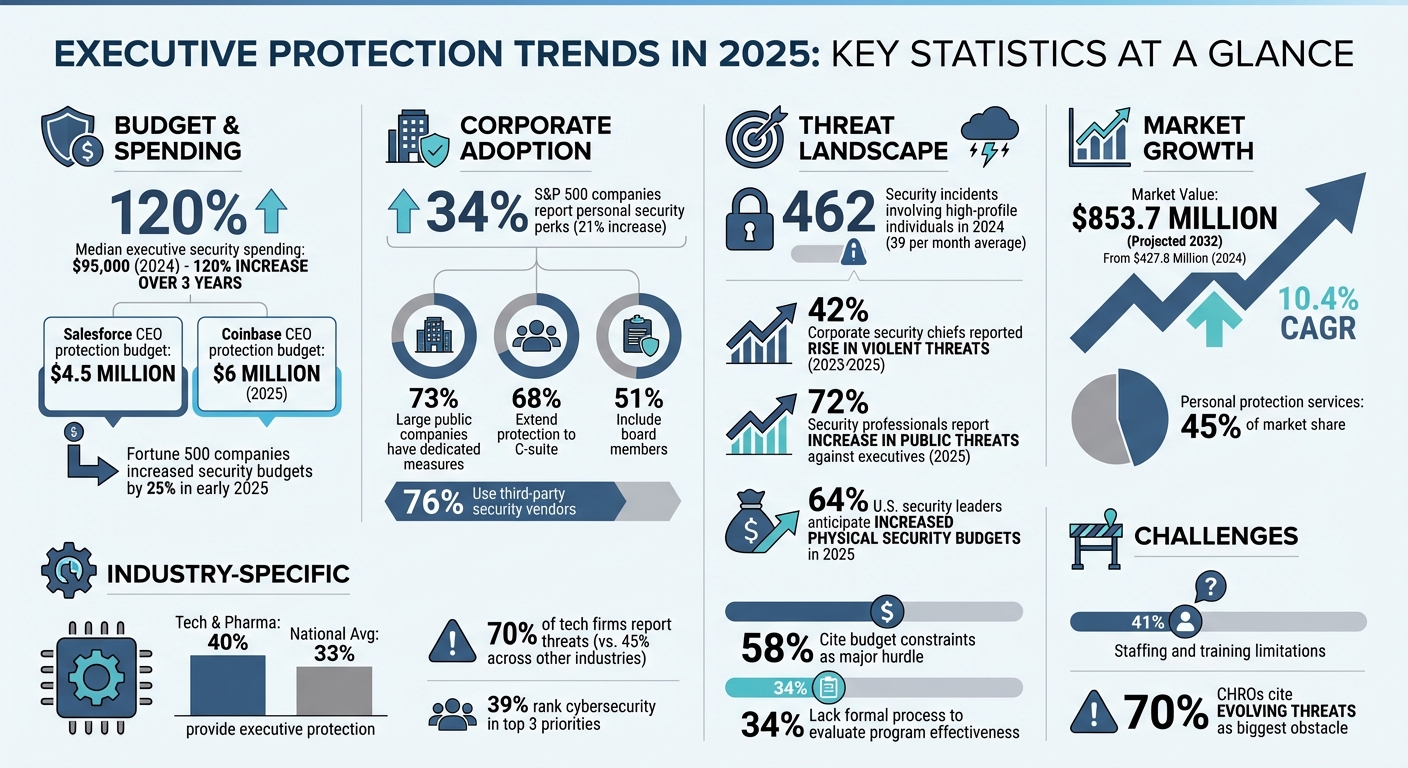
Businesses in the United States are ramping up their budgets for executive protection. In fact, 34% of S&P 500 companies have reported personal security perks in their 2025 proxies – a jump of 21% compared to the previous year. Additionally, 73% of large public companies now have dedicated security measures for their executives or senior leaders.
The technology and healthcare sectors are leading this trend. For instance, 40% of firms in both the tech and pharmaceutical industries provide executive protection, compared to the national average of 33%. A telling example is Coinbase, which spent over $6 million in 2025 to ensure the safety of its CEO, a move driven by the unique challenges of the cryptocurrency sector. Technology firms, in particular, report threats at a higher rate – 70%, compared to 45% across other industries.
This focus on security is no longer limited to just CEOs. Today, 68% of companies extend protective measures to their entire C-suite, while 51% also include board members. The reliance on external expertise is clear: 76% of companies use third-party security vendors, with decisions guided by job roles (91%) and formal risk assessments (75%).
The sharp rise in security spending reflects the increasingly blurred lines between digital and physical threats.
The overlap between cyber and physical threats has created a more challenging environment for executive protection. Cybersecurity now ranks among the top three priorities for 39% of companies, as online harassment and doxxing often escalate into physical risks. Security teams are responding by monitoring social media, scanning the dark web for threats, and using AI tools to predict potential physical attacks.
Economic and social tensions are also playing a role, amplifying vulnerabilities. Toxic online behavior can spill over into real-world violence, while protests sometimes turn dangerous. To mitigate these risks, companies are adopting digital hygiene measures, such as removing executives’ personal information from data brokers and limiting location-sharing metadata.
Recent high-profile incidents have further shaped how companies approach executive protection. For example, in response to rising threats, some firms have removed executive photos from public websites and shifted investor meetings to virtual formats. Chipotle implemented extra security for its CEO due to "threatening public discourse". Similarly, healthcare organizations like Ballad Health and Northwell Health have ramped up their security measures in response to workplace violence and direct threats.
Two tragic events in 2025 underscored the growing risks. In September, Charlie Kirk, the founder of Turning Point USA, was assassinated during a rally at Utah Valley University. Earlier that year, a gunman attacked the NFL offices in Midtown Manhattan, killing four people and injuring another. These incidents highlight the dangers faced by high-profile individuals in public spaces like transit hubs and office lobbies.
The challenges of this evolving threat landscape are evident. 70% of Chief Human Resources Officers now cite these risks as their biggest obstacle in implementing security plans. Between 2023 and 2025, 42% of corporate security chiefs reported a rise in violent threats against executives, and 64% of U.S. security leaders anticipate increased physical security budgets in 2025.
Artificial intelligence is changing the way security teams protect high-profile individuals. Instead of reacting to threats as they arise, AI tools now help predict and identify risks before they escalate. These systems monitor social media, scan open-source databases, and track digital footprints in real time, flagging suspicious behavior or threatening content for immediate review.
Tracy Reinhold, Global Chief Security Officer at Everbridge, emphasizes this shift:
"Safeguarding today’s leaders is no longer limited to simply providing a physical security detail. It demands real-time intelligence and the ability to anticipate and respond to a wide range of threats, from targeted attacks and digital doxxing to geopolitical instability".
Security teams now rely on data-driven decision-making to assess risk profiles, analyze travel patterns, and identify security gaps, moving beyond instincts and traditional methods.
Mobile threat detection has also taken a leap forward. Tools like vehicle-mounted IP cameras and wearable tech – such as smart glasses equipped with facial recognition – can identify known threats from stalker lists while executives are on the move. This capability is critical given the 462 security incidents involving high-profile individuals recorded in 2024, which averages out to 39 incidents per month. Automation tools further enhance response times, reducing disruptions during emergencies.
With AI’s predictive capabilities setting the stage, emerging tools are broadening the scope of executive protection.
Beyond AI, modern executive protection now incorporates cutting-edge hardware to ensure safety across all environments. Smart cameras, sensors, and wearable tech provide continuous monitoring and situational awareness. These Internet of Things (IoT) devices create a connected security network that tracks executives wherever they go, not just within secured facilities.
Real-time monitoring platforms integrate data from panic buttons, GPS trackers, and IoT devices into a single dashboard. This eliminates the delays that once slowed emergency responses. Security teams can pinpoint an executive’s exact location, receive instant alerts if something goes wrong, and coordinate responses across multiple teams in real time.
The blending of digital and physical security has become the norm. Trinity Davis, Managing Director of Strategic Intelligence at 360 Privacy, captures this evolution:
"We’re no longer just talking about gates, guards, and guns. We’re in the era of gates, guards, guns, and gigabytes".
Companies like 360 Privacy now support 32 Fortune 100 companies, offering proactive measures like removing executives’ personal information from public databases and monitoring dark web forums for potential threats.
While AI strengthens threat prediction, these advanced physical tools enhance on-the-ground responsiveness.
The shift from traditional to technology-driven approaches in executive protection highlights the industry’s progress. Traditional methods depended heavily on physical observation and manual reporting, often identifying threats only after they had developed. Modern strategies flip this model, using AI and data analytics to detect risks early.
| Feature | Traditional Methods | Technology-Based Approaches |
|---|---|---|
| Threat Detection | Reactive; relies on physical observation and manual reports | Proactive; uses AI for predictive analytics and social media monitoring |
| Identification | Manual review of mugshots and field interview photos | Real-time facial recognition and biometric scanning |
| Scope | Limited to the secured perimeter of a building | Mobile awareness via GPS, IoT, and wearable devices |
| Response Speed | Delayed by manual communication and alarm siloing | Accelerated by automated alerts and consolidated monitoring platforms |
| Data Usage | Static risk assessments | Dynamic, data-driven strategies based on real-time intelligence |
The 2024 assassination of UnitedHealth Group CEO Brian Thompson served as a wake-up call for the industry. This tragic event, which caused billions of dollars in market value to vanish overnight, underscored the need for integrated intelligence and cybersecurity. As Rick Mercuri, Senior Advisor for Corporate Security at Rebel Global Security, puts it, many companies have shifted from "performative" security measures to programs that combine intelligence with cyber protection.
Despite these advancements, challenges persist. 58% of security professionals cite budget constraints as a major hurdle, while 41% point to staffing and training limitations. Additionally, 34% of organizations lack a formal process to evaluate whether their protection programs are effective. Even so, the push toward technology integration continues, as modern threats demand modern solutions.
Law enforcement officers bring essential expertise to the world of executive protection. Those with criminal intelligence and detective backgrounds are especially valued for their ability to identify threats and assess risks before they escalate. Officers with federal experience – such as from the CIA, ATF, DOJ, or DHS – are sought after for their skills in real-time threat management. These professionals excel in tactical areas like firearms training, scenario-based responses, and security driving. They also understand the importance of discretion, often working in plainclothes and using unmarked vehicles to maintain a low profile.
Looking ahead to 2025, the role of executive protection will expand to include managing hybrid threats. This means officers will need to master secure communications, protect digital footprints, and leverage AI tools to detect and respond to potential dangers.
Jeff Salvetti, Vice President and Co-Founder at Blue Star, explains this modern approach:
"Effective executive protection is about tailored protection – being prepared, proactive and adaptable. It’s very different from traditional security services. The difference lies in meticulous planning, local knowledge, understanding unique client needs and anticipating risks before they become threats".
With their advanced training and experience, law enforcement professionals are well-equipped to meet these demands and excel in the field.
The specialized skills of law enforcement officers open doors to high-paying opportunities on platforms like OfficerList. This job marketplace connects active and retired officers directly with roles in executive protection. By creating industry-specific resumes that emphasize their investigative expertise, tactical training, and security background, officers can stand out to employers in the VIP protection sector.
Employers using OfficerList benefit from a vetted pool of candidates with proven abilities in threat assessment and crisis response. The platform offers a secure and streamlined hiring process, making it easier for companies to find professionals with real-world law enforcement experience.
The demand for executive protection services is surging alongside the growth of the private security market. In 2024, the executive protection industry is valued at $427.8 million and is expected to nearly double to $853.7 million by 2032, with a compound annual growth rate of 10.4%. Personal protection services already account for 45% of the market share.
Real-world events are fueling this growth. A staggering 72% of security professionals report an increase in public threats against executives as a key reason for enhanced protection measures in 2025. For example, following the December 2024 assassination of UnitedHealthcare CEO Brian Thompson, Fortune 500 companies increased their security budgets by 25% in early 2025. These trends underscore the rising importance of skilled professionals in the executive protection field.
Executive protection has evolved from being an optional service to a critical component of business resilience. The tragic murder of UnitedHealthcare CEO Brian Thompson in December 2024 served as a stark reminder of the need for professionalized security measures. In response, companies are adopting intelligence-driven, proactive strategies to safeguard operations and maintain investor trust. This shift highlights the importance of combining traditional skills with modern technology to meet emerging challenges.
Law enforcement professionals already have a strong foundation in executive protection skills, but staying ahead in 2025 means embracing new tools and approaches. Managing both physical and digital threats is now essential. As Rachelle Loyear points out, advanced technologies are enhancing traditional de-escalation techniques. Professionals who integrate AI-powered threat detection, digital security tools, and established de-escalation methods will stand out in this evolving field. With 46% of chief security officers prioritizing employee security training and skill development, this is the perfect time to broaden your expertise and adopt these advancements. Doing so positions law enforcement officers to thrive in the growing executive protection market.
For those looking to transition into executive protection, OfficerList is a great resource. This job marketplace connects active and retired officers with employers seeking VIP security experts. It allows professionals to showcase their investigative skills, tactical training, and crisis management experience. Employers, in turn, gain access to a vetted talent pool skilled in threat assessment and quick decision-making. With 64% of security leaders anticipating increased budgets in 2025, the demand for skilled professionals is rising – making now an ideal time to leverage your background in executive protection.
In 2025, executive protection will need to tackle a shifting landscape of threats. These include not only physical violence targeting corporate leaders but also the growing danger of online harassment, which has the potential to spill over into physical harm. To effectively manage these risks, security strategies must combine digital safeguards with physical protection for a more holistic approach.
The demand for these services is being fueled by global instability and economic uncertainty. This has led to an emphasis on customized risk evaluations, active threat tracking, and all-encompassing security measures designed specifically for executives.
Companies measure the success of executive protection by focusing on how well threats are reduced, incidents are prevented, and performance goals are met. This involves monitoring risks like potential physical attacks or online harassment, testing security measures through simulations, and performing regular risk evaluations. Advanced tools, such as real-time monitoring systems and threat intelligence software, play a crucial role. They enable proactive responses and quick action, helping to safeguard executives while maintaining the company’s reputation.
Law enforcement officers bring a wealth of practical skills to the world of executive protection. Their background in physical security, threat assessment, and crisis management equips them to handle the unique challenges of safeguarding VIPs. From evaluating risks to conducting surveillance and executing tactical responses, their expertise is a cornerstone of effective protection.
But it’s not just about tactical know-how. Soft skills play a huge role too. Discretion, clear communication, and a strong sense of awareness in diverse environments are just as critical. Combine these with training in cybersecurity – a must in today’s digital-first world – and you have a professional who’s ready to tackle modern threats. With additional private-sector training, law enforcement officers are well-prepared to excel in executive protection roles.